
Why Is Water Getting Into My House When My Shingles Look Fine?
By Kay LeRoy | Director of Marketing & Brand Development
Nomads Roofing
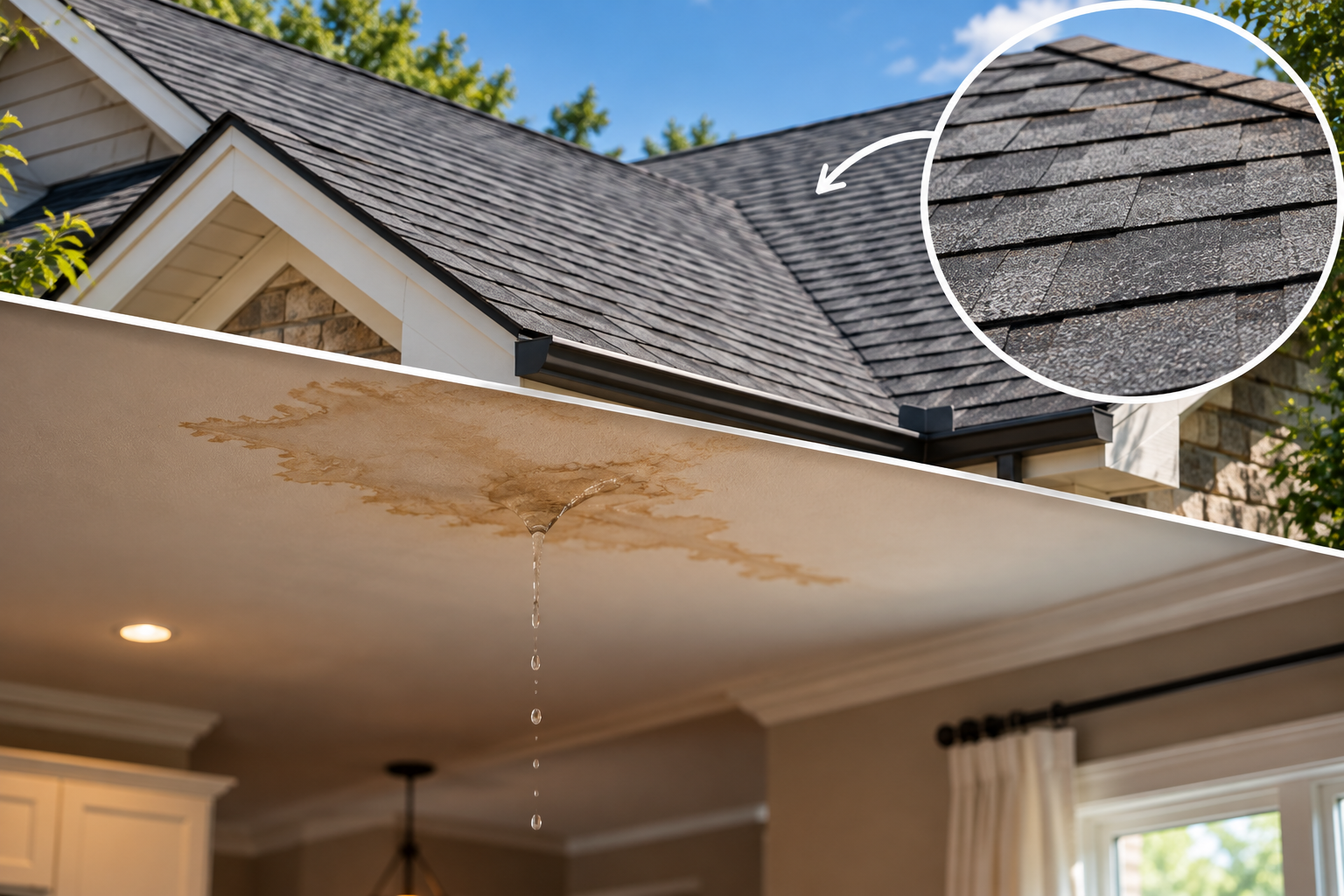
You notice a water stain on the ceiling?
Naturally, the first thing you do is look at the roof.
No shingles are missing. Nothing looks obviously damaged. From the ground, the roof actually looks pretty good.
So how is water getting inside?
Here’s the part that surprises many homeowners:
A roof can leak even when the shingles themselves are perfectly fine.
Your shingles are only one part of the roofing system. Water can find its way inside through several other areas, and sometimes the hardest part of fixing a leak is figuring out where it actually started.
The Leak May Not Be Directly Above the Water Stain
This is one of the most confusing things about roof leaks.
You see a stain on the bedroom ceiling, so you assume the problem must be directly above it.
Not necessarily.
Once water gets underneath the roofing system, it can travel.
It may follow the roof decking, framing, pipes, or other surfaces before finally dripping onto the ceiling.
That means the place where you see the water isn't always the place where the water entered the home.
Finding the source can require looking beyond the obvious spot.
Flashing Is Often Worth a Closer Look
Flashing is used in areas where different parts of the roof meet or where something interrupts the roofing surface.
You'll commonly find it around chimneys, walls, valleys, and other transitions.
These are important areas because water needs to be directed away from openings and back onto the roof.
If flashing becomes damaged, loose, improperly sealed, or deteriorates over time, water may find a path underneath the roofing system.
Meanwhile, the shingles around it may still look completely normal.
Check Around Pipe Boots
See those pipes sticking through your roof?
The roofing system has to create a watertight seal around them.
Pipe boots help protect those openings, but like other exterior components, they can age and deteriorate.
The rubber around a plumbing vent may crack or separate over time.
That can create a surprisingly small opening for water.
And a small opening is all water needs.
You can have rows of perfectly good shingles surrounding the area while the actual problem is happening around one little pipe.
Chimneys Have Several Areas Where Water Can Enter
Chimneys create another interruption in the roof.
Anywhere the roof meets a vertical surface requires careful water management.
There may be flashing around the chimney, sealants, masonry, and other components involved.
Sometimes what appears to be a “roof leak” near a chimney may involve the flashing.
Other times, the chimney itself may be contributing to the problem.
That's why simply replacing a few shingles near a chimney doesn't necessarily solve the leak.
First, you have to figure out where the water is actually coming from.
Valleys Handle a Lot of Water
A roof valley is where two roof slopes meet.
When it rains, water from both sections of the roof is directed toward that area.
That means valleys can handle a significant amount of water during a heavy Northwest Arkansas rainstorm.
If something isn't working correctly in a valley, water may get underneath the roofing materials even though the surrounding shingles appear to be in good condition.
Because valleys are such important drainage areas, they deserve careful attention when tracking down a leak.
Roof Vents Can Be Another Source
Your roof may have several types of vents depending on how the home was designed.
Every time something passes through the roof, the roofing system has to properly manage water around that opening.
A vent itself, its flashing, the surrounding seal, or another component may become a potential entry point.
Again, the shingles may not be the problem at all.
Walls and Roof Transitions Can Be Tricky
Some homes have roof sections that run into exterior walls.
These transitions require proper flashing and water management.
When water gets behind siding or enters around one of these transitions, it may eventually show up inside the home and look like a traditional roof leak.
This is another reason diagnosing water intrusion isn't always as simple as finding the closest shingle.
The source may involve the connection between different parts of the home's exterior.
Sometimes the Roof Isn't the Problem
This is an important one.
Not every ceiling stain is caused by the roof.
Plumbing, HVAC systems, condensation, windows, siding, or other parts of the home can sometimes produce moisture that looks like a roof leak.
Where the water appears, when it appears, and what's located above or around that area can provide useful clues.
For example, moisture that appears only during rain tells a different story than moisture that shows up when it hasn't rained at all.
That's why it's important to investigate before automatically assuming the roof needs to be repaired.
The Weather Can Help Tell the Story
When does the leak happen?
Only during heavy rain?
During wind-driven rain?
After several hours of steady rain?
When snow or ice begins melting?
Even when the weather is dry?
Those details matter.
Water intrusion that happens only when rain is being pushed from a particular direction may point toward a different area than a leak that appears during every rainfall.
Sometimes the homeowner's observations are some of the most useful clues in tracking down the source.
Sealant Isn't Always the Answer
When homeowners find a suspicious area, the first instinct is often:
“Just put some caulk on it.”
Sealants absolutely have a place in roofing systems.
But covering a suspicious area with sealant without understanding why it's leaking can sometimes hide the problem rather than solve it.
If water is entering because a component is damaged or improperly directing water, the better solution may involve addressing that component—not simply covering everything with sealant.
A Small Leak Doesn't Necessarily Mean You Need a New Roof
Seeing water inside the house can make any homeowner immediately think:
“I need a new roof.”
Not necessarily.
A roof leak can sometimes come from a relatively small, localized issue.
If the roofing system is otherwise in good condition, repairing the source may be all that's needed.
On the other hand, if an inspection finds widespread deterioration or several contributing issues, the conversation may be different.
The important part is matching the solution to the actual problem.
Finding the Source Matters More Than Finding a Wet Spot
When water gets into a home, the goal shouldn't simply be to make the visible stain disappear.
It's to figure out how the water got there in the first place.
That may mean looking at the shingles.
But it may also mean looking at flashing, pipe boots, vents, valleys, chimneys, wall transitions, the attic, or even parts of the home that aren't technically the roof.
Because sometimes the shingles aren't the problem at all.
Your roof is an entire system, and every piece has a job to do.
When water finds its way inside, understanding which piece isn't doing its job is what leads to the right repair.