
By Kay LeRoy | Director of Marketing & Brand Development
Nomads Roofing
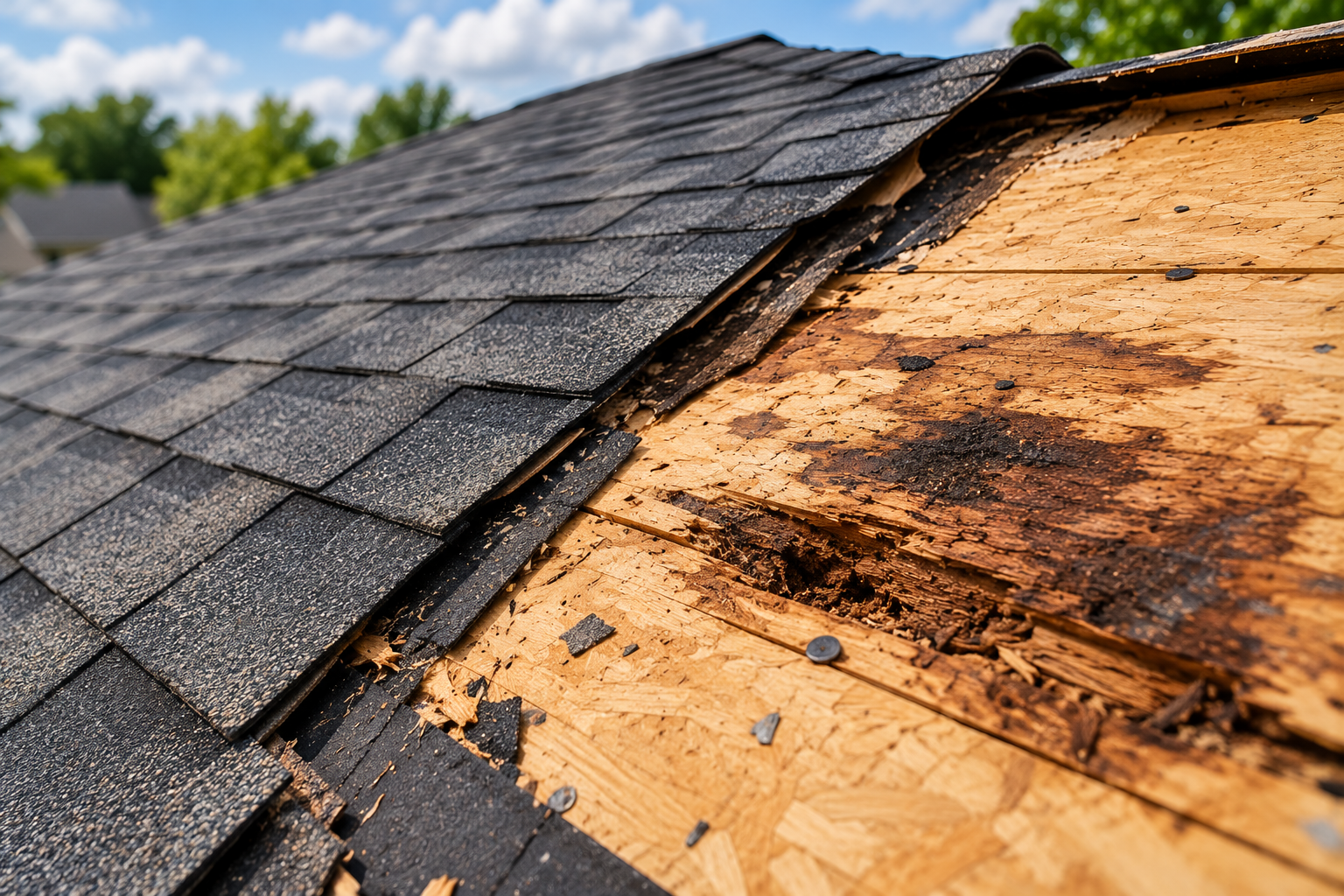
When most homeowners think about their roof, they think about shingles.
But shingles are only the part you can see.
Underneath them is one of the most important parts of the entire roofing system: roof decking.
And sometimes, homeowners don't find out there's a problem with it until their old roof is being removed.
That can lead to an understandable question:
“Why didn't we know about this before?”
The answer is actually pretty simple. You can't always see what's happening underneath a finished roof.
So, What Exactly Is Roof Decking?
Think of your roof in layers.
Your shingles are the outer layer that you see. Underneath them are protective roofing materials, and beneath those is the roof decking.
Decking is the solid wood surface attached to the structure of your roof. Depending on the home, it may be made from plywood, OSB, or wood boards.
It's what gives your roofing system a solid surface to be installed on.
In simple terms, your shingles need something strong underneath them to hold onto—and that's the decking.
Why Does Decking Matter?
A roof can only be as reliable as the surface supporting it.
Your shingles and other roofing materials need a solid, secure surface underneath them.
If decking becomes damaged, deteriorated, soft, or unable to properly hold roofing fasteners, simply covering it with new shingles doesn't fix the underlying problem.
That's why the condition of the decking matters when a roof is replaced.
Why Can't You See All of the Decking During a Roof Inspection?
Because it's covered.
During a normal roof inspection, a roofer can evaluate the shingles and other visible components of the roofing system. There may also be signs that suggest something is happening underneath.
But the roofer can't see through the shingles and protective layers to inspect every inch of wood below them.
Even looking inside the attic doesn't always tell the entire story.
Some areas may not be accessible. Insulation can block the view. Certain portions of the decking may look normal from underneath while deterioration exists on the upper surface.
That's why there is a difference between suspecting damaged decking and actually being able to see it.
There Can Be Warning Signs
Although hidden damage isn't always visible before a roof is removed, there can sometimes be clues.
These may include:
Soft areas of the roof
Visible sagging
Uneven sections
Previous or active leaks
Water staining in the attic
Moisture damage
Deteriorated wood visible from inside the attic
These signs can give a roofer a reason to suspect there may be a decking issue.
But they still may not reveal the full extent of it.
Then the Old Roof Comes Off
This is when the decking is finally exposed.
During a roof replacement, the existing shingles and roofing materials are removed. For the first time, the crew can see the surface underneath.
Sometimes everything looks great.
Other times, removing the old roofing reveals areas of decking that are deteriorated, soft, damaged, or otherwise unable to provide the proper surface for the new roofing system.
This can be a surprise to a homeowner, especially if there were no leaks inside the house.
But no visible interior leak doesn't necessarily mean every piece of decking underneath the roof is in good condition.
Why Can't You Just Put New Shingles Over Damaged Decking?
Because new roofing materials need a solid surface.
Think about trying to attach something securely to a piece of damaged or weakened wood. Even if everything looks good from the outside, the material underneath may not properly hold it.
Roofing fasteners need adequate decking to secure the roofing system.
Installing new materials over decking that needs replacement can mean starting a brand-new roof on a compromised surface.
The goal isn't just to make the roof look new.
It's to make sure the materials underneath can properly support the new roofing system.
Does Damaged Decking Mean the Whole Roof Deck Has to Be Replaced?
Not necessarily.
Decking can sometimes be damaged in isolated areas.
For example, there may be deterioration near a previous leak while the surrounding decking remains in good condition.
In those situations, only the affected areas may need to be replaced.
Other homes may have more widespread issues.
The amount of decking that needs attention should be based on what is actually found once the roof is exposed.
Why Wasn't Decking Included in the Original Estimate?
This is another question homeowners commonly have.
Before removing the existing roof, a contractor may not know exactly how much decking—if any—will need to be replaced.
Putting a specific amount into an estimate before the decking can actually be seen would require guessing.
That's why decking is often discussed separately before a roofing project begins.
Homeowners should understand what will happen if damaged decking is discovered, how they will be notified, and how any additional work will be handled.
There shouldn't be a surprise simply because decking was found.
The condition may be unexpected, but the possibility should have already been explained.
What Causes Roof Decking to Become Damaged?
There isn't just one cause.
Water intrusion is a common one, especially when moisture has been entering the roofing system over time.
But decking conditions can also be influenced by long-term moisture exposure, ventilation issues, previous roofing problems, age, installation conditions, and other factors.
Finding damaged decking doesn't automatically tell you exactly what caused it.
The surrounding conditions need to be considered too.
A Photo Can Explain a Lot
If damaged decking is discovered during your roof replacement, you shouldn't have to stand on the roof to understand what's happening.
Photos are important.
They allow homeowners to see the condition that was uncovered before it is covered back up with new roofing materials.
If wood needs to be replaced, homeowners should be able to understand where it was found, what it looked like, and what was done about it.
Once the new roof is installed, that area will be hidden again.
Documentation gives you a record of what was actually found during the project.
What's Under Your Roof Matters Just as Much as What's on Top
A beautiful new shingle doesn't mean much if the surface underneath it isn't able to properly support it.
That's why roof replacement involves more than removing old shingles and putting down new ones.
Sometimes everything underneath is exactly as expected.
Sometimes removing the old roof reveals something no one could fully see beforehand.
That doesn't necessarily mean someone missed it during the inspection.
Sometimes, the only way to know what's underneath your roof is to uncover it.
And when that happens, what matters most is understanding what was found and making sure it's addressed before it gets covered back up.